
Executive summary
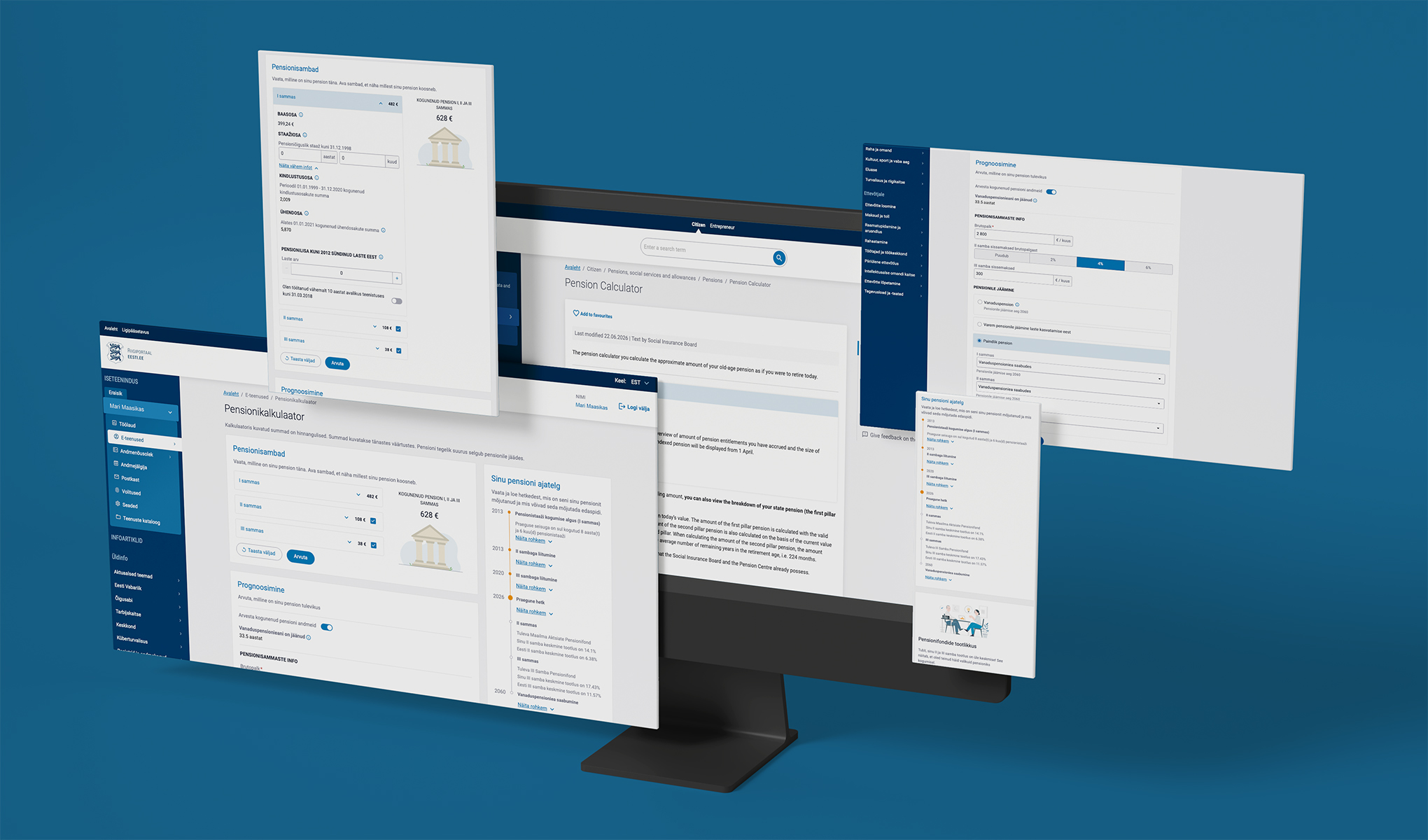
The pension calculator is a public digital service designed to give citizens a clear, personalised view of their pension situation. While the data already existed, it was difficult to interpret and only showed the current state.
Working with the Estonian Social Insurance Board, Helmes developed a new calculator that brings this data together and presents it in a simple, user-friendly way. Users can not only see their current pension status but also explore how different life and financial decisions might affect their future.
Despite a fixed scope, timeline, and budget, the project was delivered on time and within budget. The solution was launched in time for a public Pension Day event and received strong feedback from stakeholders. Delivery was supported by TEHIK, who coordinated cross-organisational dependencies and ensured the solution fits the broader welfare-sector architecture.
Meet the customer

The Estonian Social Insurance Board (ENSIB) operates under the Ministry of Social Affairs and is responsible for administering social security and welfare legislation in Estonia.
The organisation works with large-scale population data and provides services to the entire population — from youngsters to pensioners. This particular tool was designed for working-age citizens to plan their future.
For this initiative, ENSIB and Helmes collaborated closely with:
- Ministry of Social Affairs
- Ministry of Finance
- Estonian Pension Centre
- Health and Welfare Information Systems Centre (TEHIK)
These institutions contribute policy direction, regulatory oversight, and aggregated pension data across financial institutions.
The challenge
- Not a lack of data — a lack of clarity
The existing pension calculator gave users access to data, but it wasn’t easy to understand. Information was spread across many separate sections and presented without a clear structure, making it difficult to see the full picture.
- No view of the future
The tool only showed the current situation. Users couldn’t see how their decisions — such as contributions, retirement timing, or pension pillar choices — might affect their future pension.
- High delivery pressure
The project was funded under a European programme with a fixed deadline. The launch was also tied to a public Pension Day event, so delays carried both financial and reputational risks.
- Complex ecosystem
The solution needed to integrate with multiple government systems, including legacy platforms, while aligning with a new national approach to cross-portal digital services. This also meant introducing a new way of building systems within the Social Insurance Board, adding both opportunity and uncertainty to the project.
- Building the foundation for future services
The project had to establish a micro front-end (MFE) foundation within the Social Insurance Board’s self-service environment to support future digital services.
Our approach
Helmes approached the project by combining hands-on experience with a structured delivery model suited to fixed timelines and budgets.
- Experience from day one
This wasn’t a first-time collaboration. Helmes brought in a team with prior experience working with the Social Insurance Board and other government projects, which reduced onboarding time and helped avoid early risks.
- Strong foundation first
The team began with a focused discovery and architecture phase, aligning business and technical stakeholders before development started.
- Start small, scale fast, finish lean
A small core team kicked off the work, setting the foundation before scaling up to meet key deadlines. Once the main functionality was delivered, the team size was reduced again to stay within budget while refining the solution.
- Leveraging broader expertise
Helmes brought in knowledge from similar public sector projects, helping avoid unnecessary trial and error and reduce delivery risk.
- Open, trust-based collaboration
Despite tight timelines, the collaboration remained open and straightforward. Weekly sessions with product owners, architects, and analysts kept everyone aligned, with direct discussions and quick feedback helping both sides focus on solving problems rather than escalating them — something that is not always typical in large public sector initiatives.
The solution
Our team delivered a personalised pension calculator that brings together data from multiple national systems into a single, easy-to-use interface.
When users log in, the system automatically pulls up their data, including pension contributions, participation in different pillars, and historical records. In most cases, there’s no need to enter information manually, which makes the tool quick and straightforward to use.
Users can then explore how different decisions, such as changing careers or having children, might affect their future pension.
A key part of the solution is how the information is presented. Complex data is organised in a clear, structured way, with explanations that help users understand what they’re seeing and what it means for them.
Behind the scenes, the solution introduced a new way of building and integrating services within the Social Insurance Board, establishing a reusable micro front-end (MFE) foundation for future digital services and cross-portal availability. This makes it easier to include the calculator across different government portals, so users don’t need to switch systems or log in multiple times.
The solution also aligns with Estonia’s broader digital approach, leveraging shared components and integration layers to maintain service consistency across platforms.
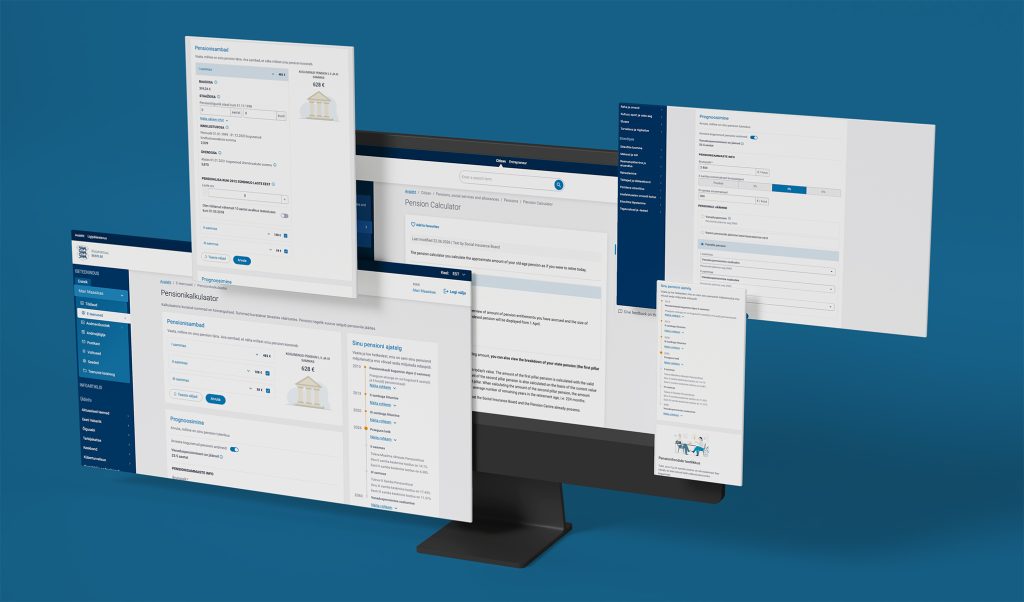
A few visuals
Measurable results
Delivery performance
- Delivered on time and within budget
- Successfully launched final version for a public Pension Day event
Adoption and scale
- No problems during peak usage of more than 10,000 users per day.
- Handled Pension Day peak traffic without incidents.
- Potential user base of over 500,000 working-age citizens.
- Designed to scale with national usage.
Client feedback
Technologies
The technology choices were driven by compatibility with the existing ecosystem and long-term maintainability.
- Angular — aligned with the government’s shared component library (TEDI)
- Java — consistent with the existing backend landscape
- REST APIs — for integrating multiple data sources
- X-TEE — secure data exchange between government systems
- Micro front-end approach — enabling cross-portal integration and future scalability
- TEDI design system — ensuring consistent user experience across services
- National portal single sign-on (SSO) integration — enabling access across environments
Future outlook
The portal in which the pension calculator was built serves as a foundation for a broader shift toward personalised public services in Estonia. As the first implementation of this architectural approach within the Social Insurance Board, it provides a practical model for building and integrating future services, such as a parental benefit calculator.
By introducing reusable components, a micro front-end (MFE) foundation, and a cross-portal approach, the solution makes it easier for future government services to be developed consistently, integrated more efficiently, and delivered with lower implementation risk.
The new version of the self-service portal can now support broader life-event-based planning scenarios, giving citizens greater control over long-term financial decisions across multiple public services.
Work with us
If you are working with complex data, multiple stakeholders, and fixed delivery constraints, we can help you structure the work and make informed decisions early — before complexity becomes a risk.
Let’s talk.
Get in touch