

Executive summary
UCLPartners’ Bedside Learning Coordinator model was designed to help observations from frontline healthcare staff reach hospital management quickly, without adding unnecessary burden to teams already working under exceptional pressure.
Initially, feedback from the ward was recorded on paper and manually transferred into Excel. As the initiative developed, it became clear that collecting, categorising and tracking this information digitally would make the process easier to manage and follow through.
Speed was critical. Rather than building every component from scratch, the team adapted existing open-source functionality and focused custom development on the needs of the BLC process.
The result was a ready-to-use MVP delivered in less than three months, giving UCLPartners a practical digital workflow for managing frontline feedback during the first wave of COVID-19.
Meet the customer
UCLPartners is a London-based health innovation partnership that brings together NHS organisations, academic and research institutions, industry, patients, and other partners to help turn healthcare innovation into real-world impact.
Since 2009, the team has worked with NHS colleagues to develop and implement solutions in hospitals, communities, GP practices and beyond, with its work extending across London, the UK and globally.
The challenge
For UCLPartners, the BLC feedback process still depended on paper and Excel. Observations from the ward had to be manually transferred and organised into five domains, while teams needed to review the information, identify required actions, and track their progress.
As the volume of information grew, UCLPartners needed a more structured way to manage this process from initial observation through to action and follow-up.
Crucially, any new solution also had to fit into a hospital environment operating under the exceptional pressures of the pandemic. It needed to be straightforward for different users and quick to put into practice, without creating additional work for frontline staff.
After recommendations from academic and commercial partners, UCLPartners approached Helmes to develop the solution.
Our approach
Given the urgency of the project, the first priority was to establish what the MVP genuinely needed to do. Helmes brought together design, engineering, architecture, DevOps, project management, and account management capabilities, working closely with UCLPartners stakeholders throughout discovery and development.
Early workshops helped the teams identify and prioritise what the MVP needed to deliver and agree on its scope and roadmap. Separate discovery and empathy sessions explored how the needs and workflows differed across the people collecting feedback, acting on it and receiving updates.
The team mapped user journeys and flows before moving into wireframes and clickable prototypes. UCLPartners remained closely involved throughout development, with the product iterated based on regular feedback.
There was also an important trade-off to consider. Building every part of the solution from scratch would have provided maximum flexibility, but it would also have taken more time. In the context of the pandemic, speed mattered.
The team therefore looked for existing technology that could provide suitable underlying functionality, allowing custom development to focus on BLC-specific aspects. It was a pragmatic choice: reuse what already worked and build what needed to be different.
“The team was very open and honest throughout the process and had a proactive “can-do” attitude. Helmes were committed to understanding our requirements in great detail, and it was clear from the beginning that they had invested extensive time reviewing the documentation we had sent and actively listening in initial discussions. They came to our first meeting very prepared and informed. They took the time to understand us and our needs.”
Jenny Shand
Director, UCLPartners
The solution
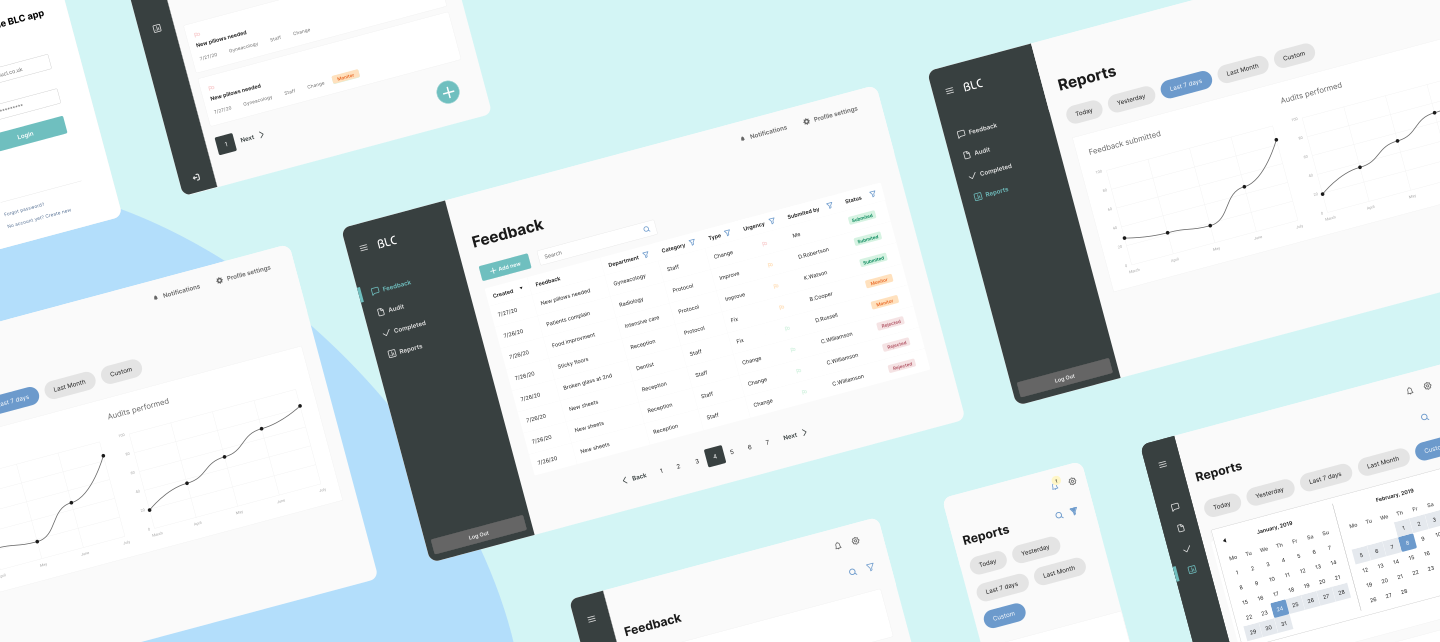
The collaboration resulted in a responsive web application designed to make frontline feedback easier to capture, organise, review, and follow through.
The application supported three groups with different responsibilities:
1. Bedside Learning Coordinators
Bedside Learning Coordinators could enter and categorise feedback, track its status, search existing information and conduct one-off audits.
See how coordinators capture and manage feedback in the video below.
2. Hospital management
Hospital management could search the database, run reports and update the progress of resulting actions.
See how hospital management reviews feedback and tracks actions in the video below.
3. Wider hospital workforce
The wider hospital workforce could view recent updates and receive notifications.
See how staff stay updated on feedback and actions in the video below.
To accelerate development, Helmes used TheHive, an existing open-source platform, as the basis for the application’s underlying case-management functionality. This avoided rebuilding underlying functionality from scratch and helped accelerate delivery of the initial application.
The resulting tool was designed to work across desktop, tablet, and mobile devices and to be straightforward to use for people with varying levels of technical confidence.
A few more visuals
Results & benefits
The clearest measurable outcome was speed: a ready-to-use MVP was delivered in less than three months, an important factor given the pressures facing healthcare teams during the pandemic.
Beyond delivery time, the BLC model gained a structured way to connect frontline observations with subsequent actions and follow-up. Teams could maintain a clearer record of what had been raised, what action was being taken, and whether changes had been followed through.
Technologies
- Languages: Scala, JavaScript, TypeScript
- Technologies: React.js, AWS, Ant Design, Redux, Docker, Nginx, Cassandra
- Integration/platform: TheHive
- Services: Business analysis and workshops, UX/UI design, web application development, front-end and back-end development, DevOps, project management
From urgent need to a practical digital solution
As an MVP, the solution provided a practical starting point for taking the BLC model from a manual process into a digital environment. Its structured approach to capturing, reviewing and following up on feedback also created a foundation that could be developed further as the process and users’ needs evolved.
For healthcare organisations looking to digitise operational processes or turn an emerging idea into a practical digital service, Helmes brings together business analysis, design and engineering to move from requirements to a working solution.
Let’s talk.
Get in touch