




Executive summary
PRIA’s central system for managing EU agricultural and rural development subsidies, covering application submission, validation, decision-making, and payouts in a single environment (MATS), was developed by Helmes through a public tender. It is a web-based Java application built with a modular “building block” approach and is used to support more than 47,000 clients. During the 2014–2020 EU budget period, close to €2 billion in subsidies were handled through the system, supporting the timely distribution of EU funding into the Estonian economy. By automating routine checks and standardising core processes, MATS has reduced processing times by 3–5×, lowered administrative effort, and helped keep operational costs and financial corrections among the lowest in the European Union.
Meet the customer
The Agricultural Registers and Information Board (PRIA) is a government agency established in 2000 and serves as Estonia’s paying agency for the European Union. PRIA is responsible for administering national and EU agricultural and rural development subsidies, as well as support from the European Maritime and Fisheries Fund and market management schemes. In addition, the agency maintains key national registers and databases related to agriculture.
A system enabling faster decisions with less manual effort and risk
Managing agricultural and rural development subsidies at a national scale is complex and highly regulated; volumes are large, rules are plentiful, and errors have direct financial consequences. With EU funding volumes increasing and compliance requirements rising, the Estonian Agricultural Registers and Information Board (PRIA) needed a secure, auditable, and highly automated system that could scale without increasing administrative costs.
A public tender was conducted by PRIA, and Helmes was selected as the partner to develop MATS* – a nationwide subsidy management system through which applications, eligibility checks, decisions, and payouts from multiple European Union funds are processed. The focus was not only on delivering a working system, but on enabling faster and more consistent decision-making, reducing manual effort, and lowering long-term administrative risk.
As Helmes Business Area Lead Ian Nelis notes, it is a great example of effective public–private cooperation. Helmes was selected based on its proposed delivery approach and technical competence. The development was carried out fully in line with agile principles, based on Scrum. Over the course of the work, this approach proved to be well suited to PRIA’s needs.
“It shows that it is possible to work with a large public-sector organisation, build a system that is important at national level, and still follow agile practices consistently,” said Nelis.
The impact: 3–5x faster subsidy processing at national scale
The system covers the full subsidy lifecycle in a single environment and is used to administer support for more than 47,000 clients. During the 2014–2020 EU budget period, close to €2 billion in subsidies were handled through MATS. As Nelis reflects: “At this scale, reliability and timeliness are not just operational concerns – they directly affect how funding reaches the Estonian economy. Contributing to infrastructure that supports this process was something we remained very aware of throughout the project.”
By moving routine checks, rule-based validation, and cross-checks to system level, MATS reduced the amount of manual work required and improved consistency across different measures, without lowering control standards. As a result, processing times have decreased by three to five times, thousands of workhours are saved annually, and administrative cost per paid euro is among the lowest when compared to other EU payment agencies. Built-in error prevention mechanisms have also kept financial corrections from the European Commission to a minimum.
These changes are also visible in day-to-day work; prior to MATS, a single measure required 17 case handlers and 70 days, whereas the same process now takes four handlers and 40 days.
“Helmes helped PRIA develop MATS, the central system for submitting, processing, deciding on, and paying out applications across different support schemes. With Helmes’ support, PRIA simplified and automated its daily work, reducing manual effort by about 76% and processing time by around 43%. The system’s high configurability allows PRIA to quickly launch new interventions with low development costs. Built-in checks improve data and control reliability, reduce errors, and help keep operational costs and financial corrections among the lowest in the EU. The new system allows PRIA to focus on well-reasoned decisions instead of routine tasks and direct its workforce toward continuous process and system improvement, including the adoption of new technologies.”
Kiido Levin
Head of Department, Development of Grants
Estonian Agricultural Registers and Information Board
The system: a web-based Java application
MATS is a web-based Java application designed with a modular “building block” approach. It consists of five core parts that communicate with each other through REST services, which means the system can be updated or fixed one section at a time without affecting the whole system. Direct access between modules is not permitted; all communication takes place through defined REST services, ensuring clear separation of responsibilities and reducing architectural risk as the system evolves.
The modular structure includes dedicated components such as the Submission and Analysis Module (SAM), On-Site Inspection Module (KKM), Direct Payments Module (OTM), Client Management Module (KHM), and Base Modules (BAM), supported by modules for external integrations (VTM), authorisation (CAS), and logging (LOG). Key business rules are configurable, allowing regulatory updates and new support measures to be implemented without code-level changes.
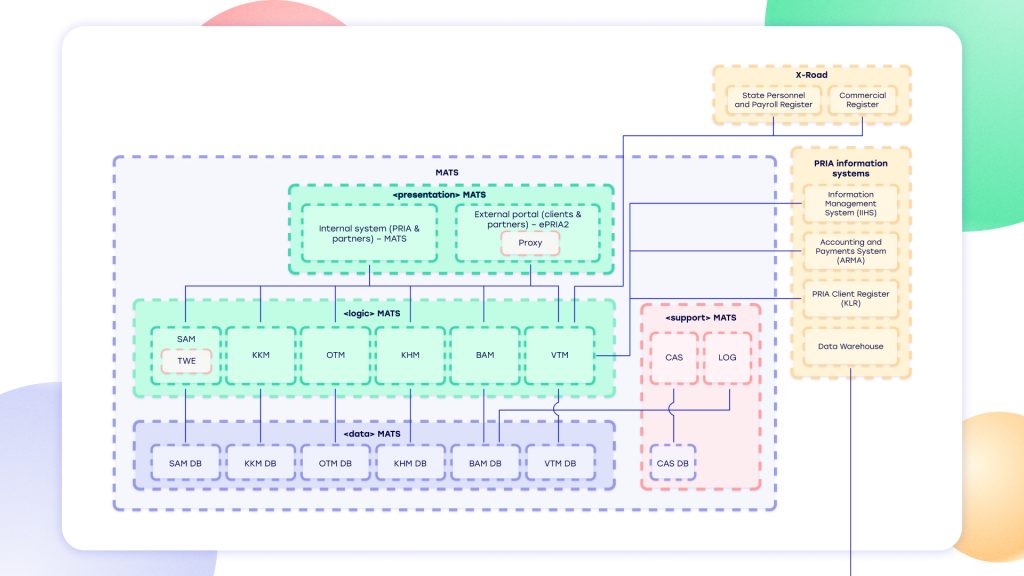
The core of the system (the backend) is powered by Spring, while the user interface is built with AngularJS, well suited for handling complex forms and workflows. For data storage, PostgreSQL is used to maintain secure records, history, and audit trails. Internal users operate through a shared interface, while external applicants access services through a separate interface built on the same technology stack.
The system is integrated with national infrastructure, including e-ID, and was built to meet strict security, data protection, and audit requirements from the very beginning, reflecting the long-term and highly regulated nature of the work it supports. The architecture is designed to remain stable over time, allowing policy changes and new measures to be implemented without structural redesign.
What changed in practice
*Fun fact. The acronym Mats comes from Maaelu Arendamise Toetuste Süsteem (Rural Development Support System), and also happens to be a common slang for what Americans refer to as someone being a “country bumpkin”.
Get in touch