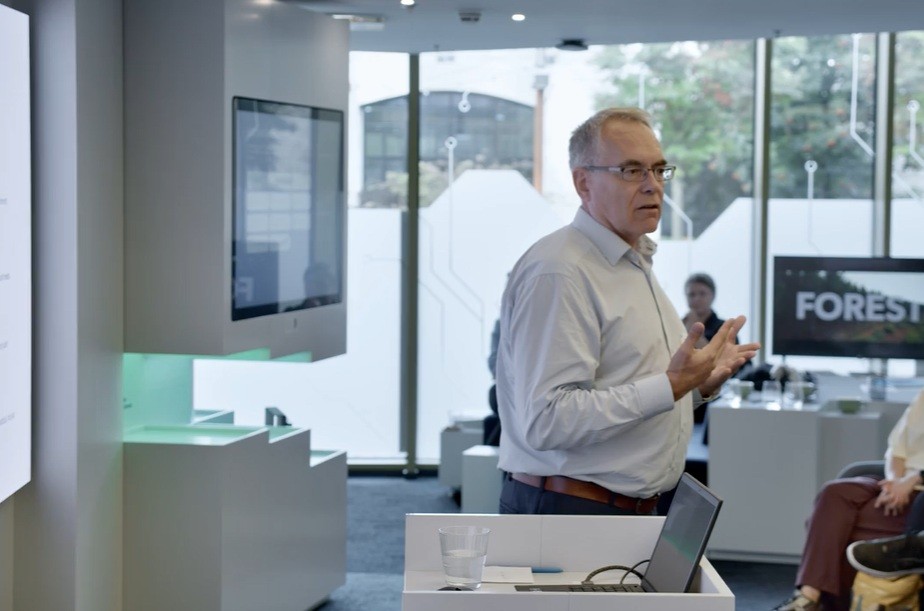
At the end of August, around 40 Deutsche Telekom professionals from across Europe joined us in Tallinn for two days of conversations about what Estonia’s digital development can teach large organisations about technology, innovation and leadership.
The group, participating in the ESMT Telekom MBA International Field Seminar met experts from across Estonia’s technology and innovation ecosystem.
Lessons from Estonia’s digital development
The programme began at the e-Estonia Briefing Centre with a closer look at the choices behind Estonia’s digital-government success. The discussions ranged from interoperability and turning policy into services people can actually use to cyber resilience and the leadership required to sustain digital change. The conversation combined experience from building Estonia’s digital government with lessons from applying that experience internationally, including perspectives from Siim Sikkut, former Government CIO of Estonia; Anett Numa, Chief of International Affairs at NEVERHACK; and Heiko Vainsalu, Senior Expert at the e-Governance Academy.
We brought a builder’s perspective to the same questions. We have spent 35 years building digital systems alongside Estonia’s digital development and with organisations internationally, including decades of work in telecommunications.
The technologies have changed enormously since 1991. Many of the underlying questions have proved rather more durable.
The two days were hosted by Martin Kolbe, Co-Founder of Helmes Germany and former Group CIO of Kühne+Nagel. After 15 years of working between Estonia and Germany, one lesson has stayed with him: structures and processes can only take an organization so far. What happens on the ground matters more. As Kolbe put it:
The complexity behind telecom
Telecom is a particularly good test of that principle. Operators have spent decades adding technologies, vendors and services to infrastructure that cannot simply be switched off and rebuilt. New systems sit alongside old ones, while apparently simple customer services can depend on complicated chains of technology behind the scenes.
We have worked with this complexity for decades, and one thing we have learned is that legacy modernisation is rarely just about replacing old technology. The real legacy is often the accumulated business logic, integrations, dependencies and knowledge around it.
“The coding itself has never been the biggest challenge,” said Deniss Ojastu, Partner and Member of the Board at Helmes. “Technologies and vendors can change, but the need to understand the business, dependencies and the whole system remains.“
AI changes the tools, not the challenge
AI changes the tools available to telecom companies, but it does not remove that underlying constraint. The list of possible applications is expanding quickly, from customer operations and network processes to software engineering. In his session, Artur Sossin, Senior AI Strategist at Helmes, focused on a question we increasingly see companies facing: how do you distinguish a genuinely valuable AI use case from something that is technically possible but solves no meaningful business problem? Sossin’s point was clear:
„Capabilities are not opportunities. The business problem has to come first.„
Artur Sossin, Senior AI Strategist at Helmes
AI-assisted software development illustrates the point. Producing code is becoming faster and cheaper, but that simply moves the bottleneck elsewhere. In a complex technology environment, the scarce resource is increasingly not the ability to build something, but the judgement to decide what should be built, how it fits with what is already there and whether it should be built at all.
The system around the technology
Faster coding can improve productivity. It can also produce technical debt faster.
That puts more weight on the organisation around the technology. For more than 20 years, we have been researching software team performance and developing our approach to autonomous teams. The technologies and methodologies have changed repeatedly. The underlying question has not: how much context, responsibility and decision-making authority can sit with the people closest to the work?
„Tools and methods alone don’t determine outcomes – the system around them does. Being agile is fundamentally about an organization’s ability to learn, adapt and lead change. High performance does not come from adopting a particular methodology or technology; it comes from how the whole system works together.„
Meelis Lang, Innovation Officer at Helmes
That question becomes even more important as technology itself becomes less exclusive. Cloud infrastructure is widely available. Powerful AI models can be adopted by competitors almost simultaneously. Development tools spread faster still.
Access is becoming a commodity. Judgement is not.
Large organisations accumulate expertise. They also accumulate assumptions about how things should be done. The harder those assumptions become to see from the inside, the more useful it is to look elsewhere.
Not necessarily for better answers, but for better questions.